Listed Building
Consent in Oxford.
Expert help with Listed Building Consent \u2014 and the sensitive work that follows. One team, from the consent paperwork to the finished restoration.
Listed Building Consent
Consent applications and sensitive restoration in Oxford.
Expert help with Listed Building Consent
and the sensitive work that follows.
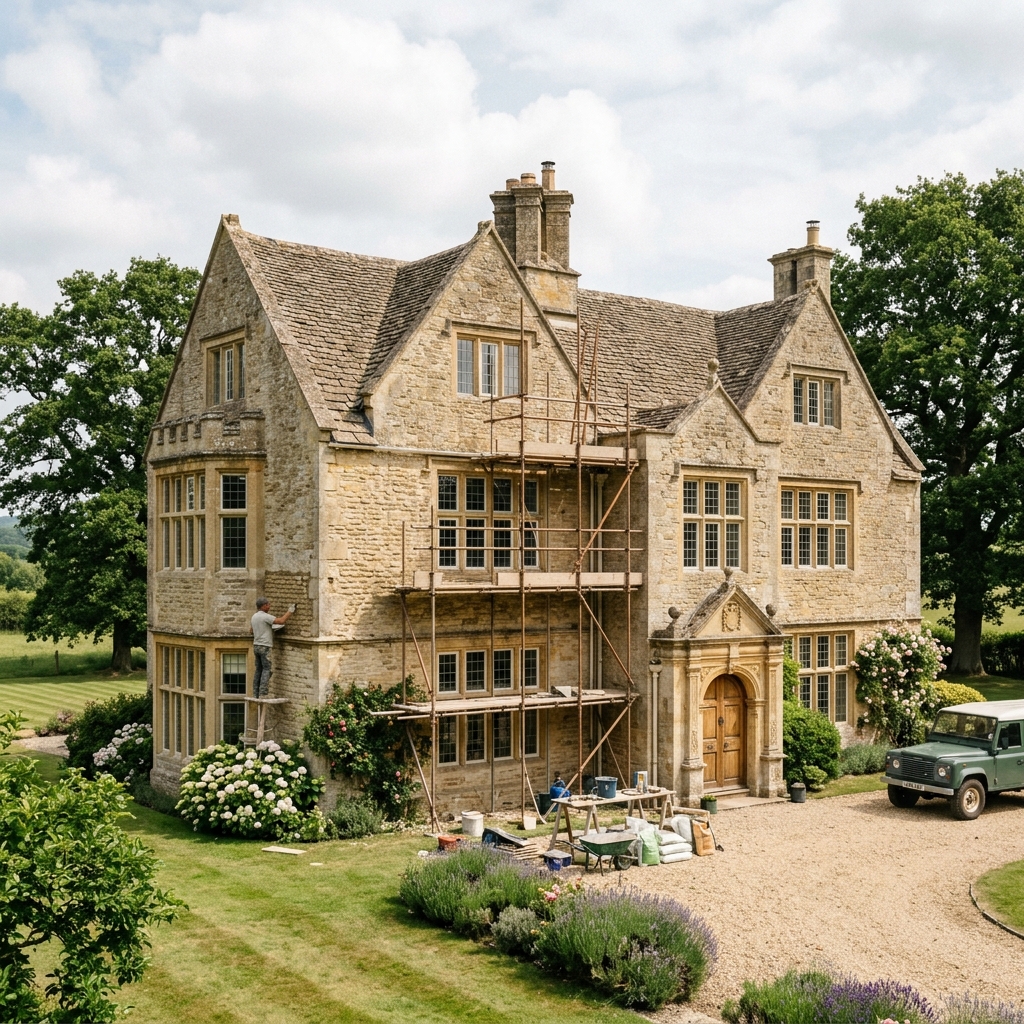
Owning a listed building in Oxford is a privilege, but it comes with real responsibility. Almost any change to a listed property \u2014 inside or out \u2014 needs Listed Building Consent before work begins, and getting that wrong carries serious consequences. Crawford Construction guides Oxford homeowners through the whole process: assessing what consent is needed, preparing and submitting the application, and then carrying out the work to the standard heritage demands.
We combine genuine craftsmanship with planning expertise, working sympathetically with original fabric and liaising with Oxford City Council's conservation team and Historic England where required. One team, from the consent paperwork to the finished restoration.
What we handle
- Listed Building Consent applications
- Heritage & significance statements
- Conservation officer liaison
- Lime mortar & traditional materials
- Sash window & joinery restoration
- Full heritage restoration & build
What is Listed Building Consent, and when do you need it?
Under the Planning (Listed Buildings and Conservation Areas) Act 1990, Listed Building Consent is required for any works to demolish, alter or extend a listed building in a way that affects its special architectural or historic interest. This applies to both the exterior and the interior \u2014 far more than people expect.
You are likely to need consent for things such as:
Routine like-for-like repair using matching materials may not need consent \u2014 but the line is fine, and the safe step is always to check before you start. We'll tell you clearly what does and doesn't require an application.
Why it matters: this is the law, not a formality
Carrying out unauthorised works to a listed building is a criminal offence. The local authority can prosecute, impose an unlimited fine, and serve an enforcement notice requiring you to undo the work and reinstate the building at your own cost \u2014 regardless of whether you knew consent was needed. It can also blight a future sale. Doing it properly from the outset protects both your home and your finances.
Good to know: There is no application fee for Listed Building Consent, unlike standard planning permission \u2014 though you may need both consents for the same project.
Understanding the grades
Listed buildings are graded by Historic England on the National Heritage List for England. Consent is required whatever the grade.
Buildings of exceptional interest (a small minority of listings)
Particularly important buildings of more than special interest
Buildings of special interest; the vast majority of listed homes
For Grade I and Grade II* works \u2014 and some Grade II \u2014 Historic England is formally consulted, which is where experience in presenting a scheme well really counts.
How the consent process works
Assessment & survey
We establish the listing details (and its curtilage, which can cover outbuildings and boundary structures), and identify what's significant about the building.
Statement of Significance & Heritage Statement
The supporting documents that explain the building's importance and justify your proposals against conservation policy (the NPPF and Oxford's local plan).
Drawings & specification
Measured drawings and a detailed specification of materials and methods.
Submission & liaison
We submit the application and engage with the conservation officer (and Historic England where required) to address questions early.
Decision & build
Once consent is granted, we carry out the work to the agreed specification, sensitively and to a high standard.
Oxford: one of England's most heritage-rich cities
Oxford has an exceptional concentration of listed buildings \u2014 from the historic centre and college quarter to the Victorian villas of North Oxford, Jericho and the period terraces across the city, many sitting within conservation areas and under Article 4 Directions that further restrict change. We know this landscape, and we know what Oxford's conservation officers expect to see \u2014 which means fewer delays and a smoother route to consent.
Sympathetic materials and methods
Heritage work is only as good as the way it's done. We use lime mortar and lime plaster, breathable traditional materials, reclaimed or matching brick and stone, and we restore rather than replace original features wherever possible.
A note on Building Regulations \u2500 Listed Building Consent is separate from Building Regulations, which still apply to most work. Sometimes the two pull in different directions \u2514 for example, energy or fire requirements versus preserving historic fabric \u2514 and resolving that sensibly takes experience. We manage both together so nothing is overlooked.
Why choose Crawford Construction
Consent and craftsmanship under one roof ─ we handle the application and the work
Heritage-sensitive methods ─ lime-based and traditional materials, repair over replacement
Local knowledge of Oxford's conservation officers, conservation areas and listed stock
Full documentation ─ Statement of Significance, Heritage Statement and measured drawings
Fixed-price, itemised quotes and one named project manager throughout
Work with conservation-accredited architects / heritage consultants • SPAB-aware methods • fully insured
Areas we serve
Oxfordshire
Listed building work across Oxford City Centre, North Oxford, Jericho, Headington, Summertown and Iffley, and throughout Oxfordshire \u2014 Witney, Burford, Woodstock, Bicester, Abingdon, Thame, Banbury, Chipping Norton and the Cotswolds, where period and listed properties are everywhere.
Start your listed building project
Tell us about your property and we'll reply within 24 hours. Free consultation, no-obligation, and 100% confidential.
Frequently asked questions
Everything you need to know about Listed Building Consent, grades and heritage work.
Often, yes. The listing protects the interior as well as the exterior — removing a wall, fireplace, staircase or original panelling, or even some replastering, can require consent. The protection covers the whole building's special interest, not just the front elevation. Always check before starting; we'll advise quickly.
It's a criminal offence. The council can prosecute, issue an unlimited fine, and serve an enforcement notice ordering you to reverse the work and reinstate the building — at your own expense. It can also cause serious problems when you come to sell. It simply isn't worth the risk.
No — unlike standard planning applications, there is no fee for a Listed Building Consent application. You may, however, need planning permission as well for the same project, which does carry a fee.
Local authorities aim to decide most applications within around eight weeks, though complex schemes — especially Grade I and II* where Historic England is consulted — can take longer. Good supporting documents and early engagement with the conservation officer are the best way to avoid delay, and that's where we add value.
Usually only with consent, and typically on a like-for-like basis — matching the style, materials and detailing of the originals. Modern uPVC replacements are rarely acceptable. We restore original sash windows where we can and replicate sympathetically where we can't.
Sometimes, yes — but it must be designed to respect the building's character and significance, and it needs both Listed Building Consent and usually planning permission. A well-judged, well-presented scheme has a far better chance, which is why the design and the supporting statements matter so much.
Curtilage listing means the protection can extend beyond the main house to certain attached or pre-1948 structures within its grounds — outbuildings, walls, gates. It catches owners out, so we establish the full extent of what's protected at the survey stage.
Both. We can prepare and manage the consent application and then carry out the restoration or alteration — giving you a single accountable team from first survey to final handover.
Let's build
somethingremarkable.
From first sketch to final handover — Oxfordshire's trusted team for homes built with precision, craftsmanship and care.